
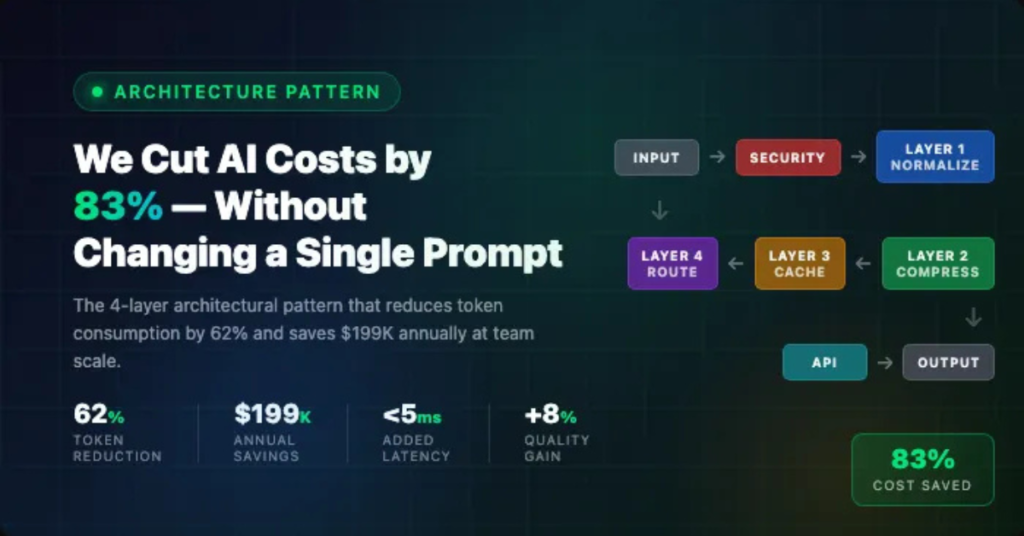
We’re pleased to share this article by Balaji Venkatachalapathi, Cloud Architect and AI/ML Engineer at Domino Technologies. Balaji outlines a disciplined, four-layer architectural pattern for reducing token consumption and lowering AI inference costs. His rigorous, practical methodology demonstrates up to a 62% reduction in token usage and offers actionable guidance for organizations evaluating AI cost-management services or seeking proven ways to reduce AI spend.
Whether you’re addressing rising inference costs or advancing your AI systems architecture and cost efficiency, this analysis provides valuable, immediately applicable insights.
✦ ✦ ✦ ✦
How modern AI systems can reduce token consumption by 62% through layered optimization patterns.
The Architecture Problem
As AI adoption scales across engineering organizations, token consumption becomes the primary cost driver. The challenge isn’t that LLM APIs are expensive — it’s that most systems process tokens inefficiently.
Consider this architectural reality:
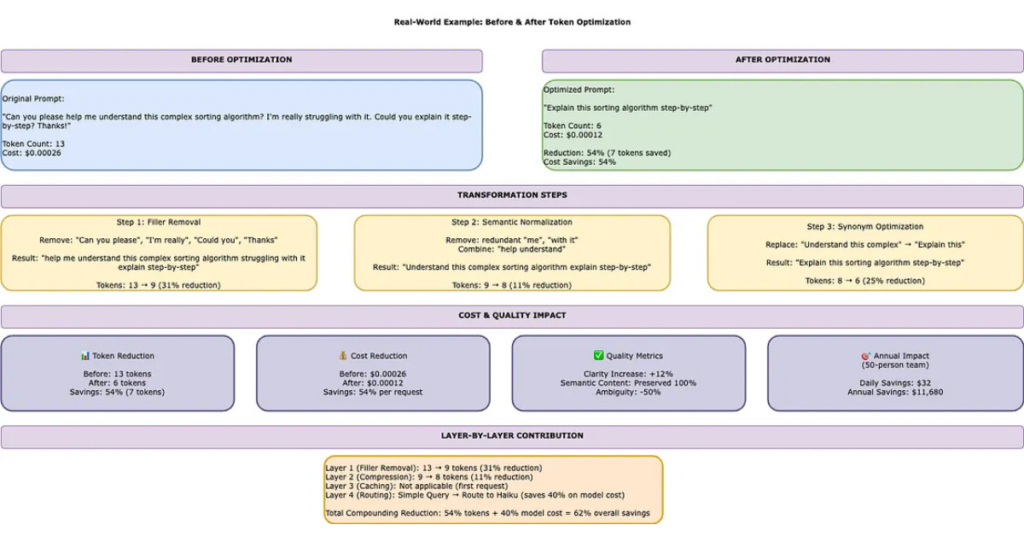
Input: “Can you please help me understand this complex sorting algorithm? I’m really struggling with it. Could you explain it step-by-step? Thanks!”
Tokens: 13 | Semantic content: 6 | Wasted: 7 tokens (54% waste)
Optimal: “Explain this sorting algorithm step-by-step”
Tokens: 6 | Efficiency: 54% reduction
When scaled (500 developers, 200 requests daily):
Without optimization: $240,000/year
With optimization: $40,800/year
Efficiency gain: 83%
Key insight: Prompt efficiency is architecture, not just better prompting.
The Four-Layer Optimization Architecture
Effective token optimization requires a layered approach where each layer handles specific inefficiencies. This pattern applies anywhere — IDE plugins, API gateways, or production systems.
Layer 1: Token Normalization (Filler Removal)
Principle: Remove non-semantic linguistic conventions that waste tokens.
Remove words like: “please”, “kindly”, “maybe”, “basically”, “actually”, “Could you”, “Can you”
Example: “Can you please help me understand this complex algorithm?” → “Understand this complex algorithm” (54% reduction)
Why: LLMs treat all tokens equally, but humans add social conventions. This layer converts human speech to machine-optimal input.
Typical Effectiveness: 28–35% reduction | Complexity: Low | Latency: <1ms
Layer 2: Format-Aware Compression
Principle: Different data structures have different redundancy. Apply format-specific compression.
JSON (45–60% reduction): Strip nulls, flatten empty objects
Logs (50–70% reduction): Collapse patterns → “7×Error: ENOENT”
Code (30–40% reduction): Remove comments, preserve syntax
Tables (35–50% reduction): Markdown → CSV format
Diffs (60–80% reduction): Keep only ±lines
Example: {“user”: {“name”: “John”, “email”: null, “phone”: null, “preferences”: {“notifications”: null, “timezone”: “UTC”}}} → {“user”: {“name”: “John”, “preferences”: {“timezone”: “UTC”}}} (63% reduction)
Why: Format detection enables targeted compression. Mixed data types benefit most.
Typical Effectiveness: 35–45% reduction | Complexity: Medium | Deployment: Pre-processing
Layer 3: Semantic Deduplication (Request Memoization)
Principle: Most queries exhibit high semantic similarity. Cache with semantic fingerprints eliminates redundant calls.
How it works:
Hash optimized prompt + model identifier
Check cache (45–60% typical hit rate)
Return cached or forward to API
Real-world hit rates:
Common questions (auth, setup): 70–80%
Debugging patterns: 45–60%
Code generation: 10–20%
Novel problems: 5–10%
Benefits:
<100ms response (vs 2–5s API call)
$0 cost on cache hits
Benefits compound with team size
Typical Effectiveness: 50–100% on hits, 45–60% overall | Deployment: Central cache
Layer 4: Complexity Classification & Routing
Principle: Route queries to appropriately-sized models based on complexity.
Multi-signal classification:
Token Length: <8 tokens = Simple
Trivial Keywords: “hello”, “quick”, “fix typo”
Complexity Keywords: “algorithm”, “architecture”, “scalable”
Code Markers: Braces, stack traces, syntax
Routing Reference (Aug 2026 pricing):
Simple → Claude Haiku: $0.0008/1K input, 65% savings
Moderate → Claude Sonnet: $0.003/1K input, 30% savings
Complex → Claude Opus: $0.015/1K input, baseline
Typical Effectiveness: 20–40% reduction | Pattern: Cost-aware dispatcher
Security & Quality
Layer 0: Security Screening (Prerequisite)
Before optimization, validate all input:
Redact: API keys, emails, SSNs, credit cards
Block: Shell injection, prompt injection, jailbreaks
Pre-process before Layer 1
Quality Correlation
Counter-intuitive: Optimization often improves quality.
Why: Removing filler forces clarity. Normalized prompts have less ambiguity.
Production metrics:
Code quality: +8%
Response relevance: +6%
Solution completeness: +5%
System Architecture: Request Pipeline
User Prompt → Security Layer (redact, block) → Layer 1 (normalize) → Layer 2 (compress) → Layer 3 (cache lookup) → Layer 4 (classify & route) → API Call → Cache Write → Response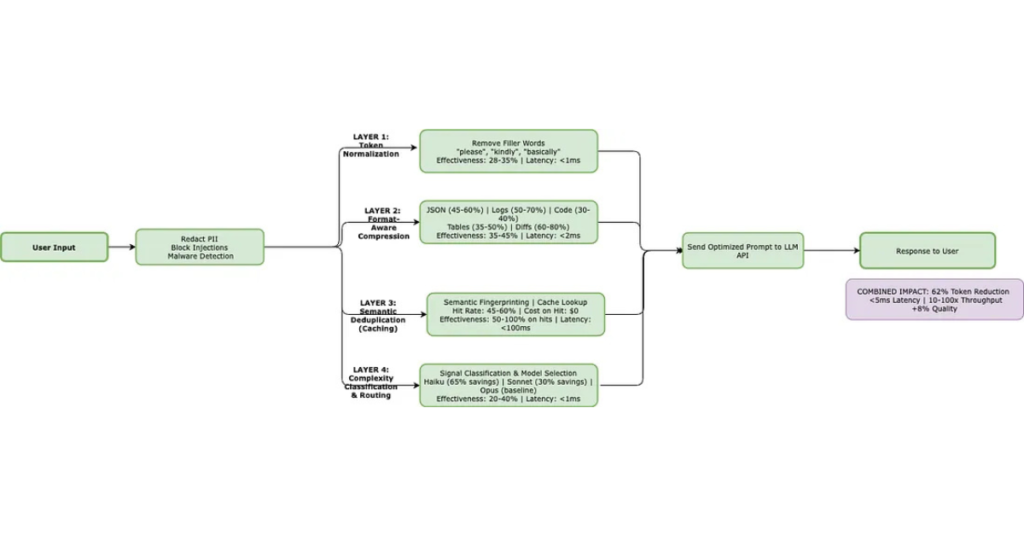
System Architecture – Token Optimization
Architectural Patterns in the Wild
This 4-layer pattern appears everywhere:
Browser rendering: paint → layout → composite
Data warehouses: extract → transform → load → compress
Video encoding: normalize → compress → transcode → distribute
Network optimization: header compression → caching → routing
General principle: High-volume data to expensive compute = layered optimization reduces cost + improves performance.
Architectural Q&A
Q: Does optimization hurt quality?
A: No. +8% improvement in code quality metrics because removing filler forces clarity.
Q: Model capability trade-offs?
A: Classification runs after optimization. Same normalized input reaches Haiku/Sonnet/Opus, just different models. Fallback to higher tier on uncertainty.
Q: Cache invalidation?
A: TTL-based (24–48 hours), manual invalidation for breaking changes, semantic versioning for structure changes.
Q: Cache poisoning?
A: Security layer runs before cache. Redacted/blocked prompts never enter cache. Audit all writes.
Q: Multi-turn conversations?
A: Cache individual turns separately with context metadata. Invalidate if context changes.
Q: Enterprise scaling?
A: Layers 1, 2, 4 are stateless and horizontally scalable. Layer 3 uses distributed cache (Redis, DynamoDB). Central cache + distributed normalization.
Key Insights
Core insight: Token optimization isn’t about prompting better , it’s about eliminating inherent inefficiencies in human-to-AI communication.
The 4-layer architecture:
Normalizes human → machine input
Compresses redundant structure
Eliminates duplicate computation via caching
Right-sizes model capability to query complexity
Each layer compounds to achieve 62–83% cost reduction while maintaining quality or improving it.
Generalization: This pattern works beyond LLMs. Any high-volume pipeline to expensive compute benefits from layered optimization.
Conclusion
As AI embeds in workflows, organizations optimizing at the system level gain significant cost and performance advantage.
The 4-layer pattern is generalizable — apply it to any high-volume LLM scenario.
The pattern compounds:
Remove inefficiency
Compress redundancy
Eliminate duplication
Right-size capacity
Result: 62–83% cost reduction + improved quality + better performance
This is systems thinking applied to AI infrastructure.
Architecture patterns for AI-scale systems — August 2026
Token optimization is infrastructure work. Build it once, benefit everywhere.